Showing posts with label Travel. Show all posts

Oct 31, 2011

Books about Vietnam - A selection by Stoessel

Original Titles in English
Compiled by Author Stoessel
By categories: Vietnam War, Contemporary Vietnam, Travel

"Books about Vietnam

These are books I can recommend if you want to get good background knowledge as well as up-to-date information on Vietnam. I limited my personal comments to the books to a minimum. Click on the link at each individual book listing to learn more (summaries, commentaries from authors, editors, and readers) at Amazon, where you can also order directly if you want. Just click on the title of each individual book you are interested in.

Vietnam war


History

Personal accounts


  • Vietcong Memoir - by Troung Nhu Tang, Doan Van Toai, Van Toai Doan (June 1986)
    - 
    Note: What about getting the other side's point of view first?
  • Vietnam Voices : Perspectives on the War Years 1941-1975 (November 1988)
    - Note: 
    First-hand, unedited accounts about the French and American period of the Vietnam war.
  • 365 Days - by Ronald J. Glassner, Ronald Glassner
    - Note: 
    Tells you what it was like to be a simple soldier in the Vietnam war.
  • Four Hours in My Lai - by Michael Bilton, Kevin Sim (March 1993)
    - Note: 
    A complete account of the massacre that killed the most innocent civilians in the shortest period of time during the Vietnam conflict. If you want to talk about war crimes today in the Balkans, you must first read this book.
  • Platoon - Bravo Company- by Robert Hemphill, Joseph L. Galloway, Pia S., Ph.d. Seagrave (October 1998)
    - Note: 
    You've seen the movie? These real platoons were not happy with how Bravo Company was portrayed.
  • Acceptable Loss - by Kregg, P.J. Jorgenson (December 1995) - Note: The true-to-life story of a volunteer Ranger, racing to the aid of soldiers who faced the same dangers he had barely survived in the jungles of Vietnam.
  • Memories of a Pure Spring - by Duong Thu Huong, Nina McPherson, Huy Ng Phan - Note: Vietnamese dissident author Huong critisizes the Vietnamese Communist party. Focused on people working in the arts. 

Novels

The 100th Kill : A Novel of Vietnam - by Charles W. Sasser (February 1997)
To kill 100 human beings in the name of freedom.

Traveling to Vietnam


(Source: http://www.stoessel.ch/vietnamflash/vietnambooks.htm)


About YourVietbooks.com
YourVietBooks is a selection of books and articles on and about Vietnam. Categories include: Culture, History, Vietnam War, Politics, Biographies, Contemporary Vietnam, International Relations, Doing Business in Vietnam, Reference and Languages, Zen Buddhism, Philosophy, Art and Literature.
Some articles are available only in English, French, German or Vietnamese. Our qualified and experienced translators can provide translations of e-books or articles on demand. Read more...


Samples of Translation | Our Translators | Need a quote? | Contact us

Oct 30, 2011

To Vietnam With Love. A Travel Guide for the Connoisseur

Original Title in English
By Authors: Kim Fay (Editor), Julie Fay Ashborn (Photographer)
Series: To Asia with Love (2008)
ISBN-13: 978-1934159040

Book Description
Born from the Southeast Asian guidebook that The International Herald Tribune's Thai Day hailed as a guide with depth and color that most of [its] competitors lack, To Vietnam With Love: A Travel Guide for the Connoisseur launches the To Asia With Love series. This beautiful, full-color guidebook features a collection of personal essays by savvy expatriates, seasoned travelers, and inspired locals. Each reflection on a favorite dining, shopping, sightseeing, or cultural experience is paired with a practical fact file, so that readers can follow in the writers footsteps. From staying overnight with a local hill tribe and climbing Southeast Asia's highest mountain, to touring historic French villas and getting involved with local charities, every recommendation captures a distinctive aspect of the country.

About the Authors
Editor Kim Fay first traveled to Southeast Asia in 1991. Since then, she spent four years living in Vietnam and has traveled back frequently, writing about the region. She is the creator and series editor of the To Asia With Love guidebooks, and the author of Communion: A Culinary Journey Through Vietnam.
Photographer Julie Fay Ashborn's travels through Southeast Asia inspired her photography in To Asia With Love, The Little Saigon Cookbook, and Communion: A Culinary Journey through Vietnam

To order: http://www.amazon.com/Vietnam-Love-Travel-Guide-Connoisseur/dp/1934159042/ref=pd_sim_b_5


About YourVietbooks.com
YourVietBooks is a selection of books and articles on and about Vietnam. Categories include: Culture, History, Vietnam War, Politics, Biographies, Contemporary Vietnam, International Relations, Doing Business in Vietnam, Reference and Languages, Zen Buddhism, Philosophy, Art and Literature.
Some articles are available only in English, French, German or Vietnamese. Our qualified and experienced translators can provide translations of e-books or articles on demand. Read more...


Samples of Translation | Our Translators | Need a quote? | Contact us

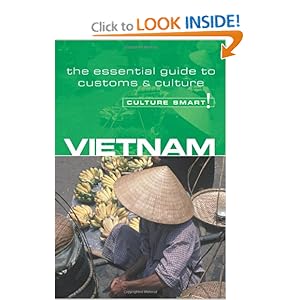
Vietnam - Culture Smart!: the essential guide to customs & culture

Original Title in English
By Author: Geoffrey Murray
Publisher: Series Culture Smart! (2006)


About the Series:
Culture Smart! provides essential information on attitudes, beliefs and behavior in different countries, ensuring that you arrive at your destination aware of basic manners, common courtesies, and sensitive issues. These concise guides tell you what to expect, how to behave, and how to establish a rapport with your hosts. This inside knowledge will enable you to steer clear of embarrassing gaffes and mistakes, feel confident in unfamiliar situations, and develop trust, friendships, and successful business relationships.
Culture Smart! offers illuminating insights into the culture and society of a particular country. It will help you to turn your visit-whether on business or for pleasure-into a memorable and enriching experience. Contents include

  • customs, values, and traditions
  • historical, religious, and political background
  • life at home
  • leisure, social, and cultural life
  • eating and drinking
  • do's, don'ts, and taboos
  • business practices
  • communication, spoken and unspoken
About the Author
GEOFFREY MURRAY has worked in Asia for more than forty years as a journalist, author, and teacher, including long stays in China, India, Japan, and Singapore. So far, he has published fifteen books on a wide range of business and socioeconomic issues, mostly about China, but also including Vietnam: Dawn of a New Market and Simple Guide to the Customs and Etiquette of Vietnam, both in 1997. He has closely followed developments in Vietnam ever since he served as a news agency war correspondent with the Australian army in the mid-1960s, winning the Australian government’s “Vietnam Logistic and Support Medal.” He is officially listed as a Vietnam War veteran by the Australian government.

To order: http://www.amazon.com/Vietnam-Culture-essential-customs-culture/dp/1857333330/ref=pd_sim_b_2


About YourVietbooks.com
YourVietBooks is a selection of books and articles on and about Vietnam. Categories include: Culture, History, Vietnam War, Politics, Biographies, Contemporary Vietnam, International Relations, Doing Business in Vietnam, Reference and Languages, Zen Buddhism, Philosophy, Art and Literature.
Some articles are available only in English, French, German or Vietnamese. Our qualified and experienced translators can provide translations of e-books or articles on demand. Read more...


Samples of Translation | Our Translators | Need a quote? | Contact us
Vietnam: A Traveler's Literary Companion

Original Title in English
By Authors: John Balaban (Author), Nguyen Qui Duc (Author)
Publisher: Traveler's Literary Companions
ISBN-13: 978-1883513023


About the Book:
Since relations between the U.S. and Vietnam have normalized, many more people are traveling to this exotic country, previously closed to a generation of Western visitors. Vietnam provides one of the first chances for Americans to know the Vietnamese outside the context of war. Vietnamese have been telling stories for thousands of years, in poetry and in song, in Chinese script and then in Vietnamese nôm, and more recently, in novels and short stories. These 17 stories, from contemporary Vietnamese writers living in Vietnam and abroad, take the literary traveler to extraordinary places: from the jungle-clad mountain ranges of the North to the mysterious silence of the old capital along the Perfume River. Proximity of the spirit world, love of family, exhaustion from war, one's Confucian, Taoist, and Buddhist obligations, social protest, and the hunger for a better life — these are some of the concerns to be encountered in these thrilling landscapes. Contributors include Nguyen Huy Thiep, Linh Bao, Nguyen Ba Trac, Thich Duc Thien, Ho Anh Thai, Le Minh Khue, Doan Quoc Sy, Vu Bao, Duong Thu Huong, Andrew Q. Lam, Nguyen Qui Duc, Qui The, Bao Ninh, and Pham Thi Hoai.

To order: http://www.amazon.com/Vietnam-Travelers-Literary-Companion-Companions/dp/1883513022/ref=pd_sim_b_4)


About YourVietbooks.com
YourVietBooks is a selection of books and articles on and about Vietnam. Categories include: Culture, History, Vietnam War, Politics, Biographies, Contemporary Vietnam, International Relations, Doing Business in Vietnam, Reference and Languages, Zen Buddhism, Philosophy, Art and Literature.
Some articles are available only in English, French, German or Vietnamese. Our qualified and experienced translators can provide translations of e-books or articles on demand. Read more...


Samples of Translation | Our Translators | Need a quote? | Contact us

Jul 22, 2011

Travel to Vietnam - Nhatrang City and Khanh Hoa Province

Travel to Vietnam
Nhatrang City - Khanh Hoa Province


Original Title in Vietnamese: Du lịch miền Trung và Tây Nguyên - Những điều cần biết: Nha Trang Khánh Hòa
By Authors: Nguyen Gia Nung, Thia Ly, Nguyen van Thanh, Khanh Hoa Tourist Ofice
Journalists: Nguyen Hoang Ba, Khue Viet Truong, Dinh Hanh, Dang Minh Chau
Publishers: Chính Trị Quốc Gia (National Politics)


About the Book:
Published in 1998, the information contained in this book is now obsolete but the book itself shows the early efforts of the provincial and central government to gather valuable information for the visitors to Vietnam. More complete information are available under wikipedia.


Complementary from wikipedia

Geography

Nha Trang city has a metropolitan area of 251 km² and population of about 500,000 (as of 2007). It borders Ninh Hòa town by the north, Cam Ranh city by the south, Diên Khánhtown by the west and the South China Sea to the east. The city is located on the beautiful Nha Trang Bay, which was chosen by Travel and Leisure in two succeeding years as one of 29 most beautiful bays in the world. Nha Trang is surrounded on all three sides by mountains and a large island on the fourth side (in the ocean directly in front of the city's main area), blocking major storms from potentially damaging the city.

Origin of the name

According to some researches, the name Nha Trang derives from a false Vietnamese spelling of a geographical name in the Cham language of the site Ya Trang (lit. Reed River), the name of the now Cai River as referred to by the Cham people. From the name of this river, the name was adopted to call what is now Nha Trang, which was officially made Vietnam's territory in 1653.
As far as the recorded naming of Nha Trang is concerned, in Toàn tập Thiên Nam Tứ Chí Lộ Đồ Thư, a geographical book written by a Vietnamese scholar with the family of Đỗ Bá in the second half of the 18th century, the name Nha Trang Môn ("Nha Trang gate") was mentioned.[4]In another map dating to the 17th century, known as Giáp Ngọ Niên Bình Nam Đồ by a noble called Đoan Quận công Bùi Thế Đạt, the name Nha Trang Hải môn (Nha Trang Sea Gate) was also cited.[4] In Vietnamese recorded historic bibliographies, these books are perhaps the earliest ones that mentioned this place name.
In a work by Lê Quý Đôn called Phủ biên tạp lục (1776), many Nha Trang-related names were also mentioned, such as đầm Nha Trang, dinh Nha Trang, nguồn Nha Trang, and đèo Nha Trang.

Education

Nha Trang is home to a multidisciplinary university, Nha Trang University (formerly Nha Trang Fishery University); Naval Academy; Air Force Academy; Normal (Teacher's) College; Kindergarten Teacher's Training College; and Arts and Tourism College. The city is home to the many high schools. Nha Trang Oceanography Institute, the unique institute of oceanography in Vietnam, Nha Trang Pasteur Institute one of the famous Pasteur Institutes in Vietnam are located in Nha Trang.

Economy

Nha Trang's economy relies largely on tourism. In the suburban areas around the city, the shipbuilding industry has developed and contributed significantly to the city's economy. Fishery and services are also important to the city. Khanh Hoa Province in general and Nha Trang is particular are among the largest contributors to Vietnam's annual budget revenues. Lobster farming on the sea is an important industry for the people living in suburb areas of the city. To the south of the city, by Cam Ranh Bay, several industrial parks are under construction and have been partly available for investors. Once the construction of the deep-water port on Van Phong Bay has been completed, this area will become the third important economic zone in the province (besides Nha Trang and Cam Ranh).

Tourist attractions

  • Alexandre Yersin Museum
  • Boat tour on Cai River, visiting islands off the coast and Ba Ho Waterfall.
  • Palace of Emperor Bảo Đại
  • Thap Ba Hot Spring (Lady Tower hot spring)
  • Nha Phu Lagoon
  • Hoa Lan Stream (Orchid Flower tream)
  • Monkey Island
  • Sạn Beach
  • Nha Trang Booze Cruise (All you can Drink Party Boat)
  • Hòn Tằm Island (Silkworm island)
  • Hòn Mun Island (Ebony island)
  • Hòn Con Sẻ Tre Island (Bamboo Sparraw island)
  • Hòn Ông Island
  • Đảo Yến Island (Swiftlet island)
  • Hòn Tre Island (Bamboo island)
  • Suối Đổ Stream
  • Suối Tiên Stream (Fairy stream)
  • Hòn Bà Mountain
  • Cai River Minigolf & Restaurant & Marina
  • Yangbay Waterfall
  • Tháp Bà Pô Nagar Nha Trang (a Champa Tower)
  • Chùa Long Sơn (Long Son Pagoda- literral: The Dragon Mountain pagoda or White Buddha Pagoda)
  • Nha Trang Oceanography Institute, the largest of its kind in Indochina where thousands of oceanic life samples, exhibits are on display. It is also home to the largest oceanic library in Vietnam.
  • Chánh Tọa Church (or Mountain Church)
  • Nha Trang Pasteur Institute
  • Trí Nguyên Aquarium (an aquarium where hundreds of rare oceanic species are fed)
  • Vinpearl Cable Car

External links


About YourVietbooks.com
YourVietBooks is a collection of books on Vietnam for Readers who are interested in Vietnam's History, Culture, Language, Economy, or Business. Most titles are in English, but some are only available in French or Vietnamese. We can provide interested parties an accurate translation of some parts of the books for your research purposes. Translations are done by YourVietnamExpert's qualified and experienced translators. contact@yourvietnamexpert.com

Jul 19, 2011

Vietnam Journeys

Original Title in English
by Author: Fields, Charles, 2010 
ISBN: 978 0 9823196 7 3
Publisher:
Fields Publishing
Source: New Asia Books
Short description
A collection of colour images that captures the myriad colours, textures, and rhythms of Vietnam. It Portrays landscapes, cityscapes, fishing villages, customs, culture, commerce, cuisine, and the friendly and optimistic people of this vibrant region.
Full description
The myriad colours, textures, and rhythms of Vietnam are captured in this collection of compelling colour images. Landscapes, cityscapes, fishing villages, customs, culture, commerce, cuisine, and the friendly and optimistic people of this vibrant region are portrayed in striking detail. Featured sites include the terraced mountainsides of Sapa, the Phung Hiep floating market, the World Heritage Sites of Hue and Halong Bay, and the Thien Mu Pagoda. Lush deltas, pristine forests, bustling markets, serene temples, and breathtaking sunsets on white sand beaches reveal the many facets of this complex and captivating nation.

French translation by Anh Tho Andres @YourVietnamExpert.com
Vietnamese translation by Cuong Phan, Kim Hoang, Bich Hong, Bao Han
German translation by Han Dang-Klein
Italian translation by Phan Cong Danh
Japanese translation by Hong Anh


About YourVietbooks.com
YourVietBooks is a collection of books on Vietnam for Readers who are interested in Vietnam's History, Culture, Language, Economy, or Business. Most titles are in English, but some are only available in French or Vietnamese. We can provide interested parties an accurate translation of some parts of the books for your research purposes. Translations are done by YourVietnamExpert's qualified and experienced translators. contact@yourvietnamexpert.com

Jul 15, 2011

Indochina Discovery - One Definition a Day: Champa, Kingdom of Cham

Indochina Discovery
Champa (chäm`pä), the kingdom of the Chams, 
which flourished in Vietnam from the 2d cent. A.D. until the 17th cent. At its greatest extent it occupied Annam as far north as central Vietnam. Its culture was strongly affected by Hindu influences. In its early period, Champa mainly warred with China and was forced to change its capital several times; late in the 9th cent. its capital was established in the neighborhood of Hué, and the later capital was Vijaya, farther south. Champa repeatedly made war on its stronger neighbor, Annam; it was sometimes allied and sometimes opposed to the Khmer Empire. In the 12th cent. the Chams invaded Cambodia and sacked Angkor; subsequently they fell for a time under Khmer rule. Decisively defeated by the Annamese in 1472, the Chams were forced to yield most of their territory N of Tourane (Da Nang). In the 17th cent. the rest of the Cham kingdom fell to the Annamese, and the remnants of the people were scattered. Chams still form small, impoverished minorities in South Vietnam, but in Cambodia a large colony prospers. Although most of those in Annam are Hindus, those of Cambodia are Muslim. Ruins of Cham temples, adorned with bas-reliefs and with statues, are found along the coast of Vietnam.

Bibliography
See G. Maspéro, The Kingdom of Champa (tr., 1949); G. Coedès, The Indianized States of Southeast Asia (1968).

French translation by Anh Tho Andres @YourVietnamExpert.com
Vietnamese translation by Cuong Phan, Kim Hoang, Bich Hong, Bao Han
German translation by Han Dang-Klein
Italian translation by Phan Cong Danh
Japanese translation by Hong Anh


About YourVietbooks.comYourVietBooks is a collection of books on Vietnam for Readers who are interested in Vietnam's History, Culture, Language, Economy, or Business. Most titles are in English, but some are only available in French or Vietnamese. We can provide interested parties an accurate translation of some parts of the books for your research purposes. Translations are done by YourVietnamExpert's qualified and experienced translators. contact@yourvietnamexpert.com

Indochina Discovery - One Definition a Day: Khmer Empire

Indochina Discovery
Khmer Empire (kəmĕr`), ancient kingdom of SE Asia

In the 6th cent. the Cambodians, or Khmers, established an empire roughly corresponding to modern Cambodia and Laos. Divided during the 8th cent., it was reunited under the rule of Jayavarman II in the early 9th cent.; the capital was established in the area of Angkor by the king Yasovarman I (r. 889–900). The Angkor period (889–1434), the golden age of Khmer civilization, saw the empire at its greatest extent; it held sway over the valleys of the lower Menam (in present-day Thailand) and the lower Mekong (present-day Cambodia and Vietnam), as well as N into Laos.

The Khmer civilization was largely formed by Indian cultural influences. Buddhism flourished side by side with the worship of Shiva and of other Hindu gods, while both religions coalesced with the cult of the deified king. In the Angkor period many Indian scholars, artists, and religious teachers were attracted to the Khmer court, and Sanskrit literature flourished with royal patronage.

The great achievement of the Khmers was in architecture and sculpture. The earliest known Khmer monuments, isolated towers of brick, probably date from the 7th cent. Small temples set on stepped pyramids next appeared. The development of covered galleries led gradually to a great elaboration of plan. Brick was largely abandoned in favor of stone. Khmer architecture reached its height with the construction of Angkor Wat by Suryavarman II (r. 1113–50) and Angkor Thom by Jayavarman VII (r. 1181–c.1218). Sculpture, which also prospered at Angkor, showed a steady development from relative naturalism to a more conventionalized technique. Bas-reliefs, lacking in the earliest monuments, came to overshadow in importance statues in the round; in the later stages of Khmer art hardly a wall was left bare of bas-reliefs, which conveyed in the richness of their detail and vitality a vivid picture of Khmer life.

The Khmers fought repeated wars against the Annamese (see Annam) and the Chams; in the early 12th cent. they invaded Champa, but, in 1177, Angkor was sacked by the Chams. After the founding of Ayuthia (c.1350), Cambodia was subjected to repeated invasions from Thailand, and the Khmer power declined. In 1434, after the Thai captured Angkor, the capital was transferred to Phnom Penh; this event marks the end of the brilliance of the Khmer civilization.

Bibliography
See L. P. Briggs, The Ancient Khmer Empire (1951); J. Audric, Angkor and the Khmer Empire (1972); J. R. Coburn, Khmers, Tigers, and Talismans (1978).

French translation by Anh Tho Andres @YourVietnamExpert.com
Vietnamese translation by Cuong Phan, Kim Hoang, Bich Hong, Bao Han
German translation by Han Dang-Klein
Italian translation by Phan Cong Danh
Japanese translation by Hong Anh


About YourVietbooks.com
YourVietBooks is a collection of books on Vietnam for Readers who are interested in Vietnam's History, Culture, Language, Economy, or Business. Most titles are in English, but some are only available in French or Vietnamese. We can provide interested parties an accurate translation of some parts of the books for your research purposes. Translations are done by YourVietnamExpert's qualified and experienced translators. contact@yourvietnamexpert.com

Indochina Discovery - One Definition a Day: Cambodia's Civil War - Khmer Rouge

Cambodian Civil War
In Apr., 1970, U.S. and South Vietnamese troops entered Cambodia to attack Communist bases and supply lines. U.S. ground forces were withdrawn by June 30, but South Vietnamese troops remained, occupying heavily populated areas. The actions of the South Vietnamese troops in Cambodia and the resumption of heavy U.S. air bombings in their support, with the inevitable destruction of villages and killing of civilians, alienated many Cambodians and created considerable sympathy for the Communists. The number of Cambodian Communists (known as the Khmer Rouge) increased from about 3,000 in Mar., 1970, to over 30,000 within a few years. Most of the North Vietnamese and Viet Cong troops were able to withdraw, leaving in progress a raging civil war fought by Cambodians but financed by the United States, North Vietnam, and Communist China.

Indochina Discovery - One Definition a Day: Tonkin

Indochina Discovery

Tonkin (tŏn`kĭn`, tŏng`–),

Historic region (c.40,000 sq mi/103,600 sq km),

in SE Asia, now forming the heartland of N Vietnam. The capital was Hanoi. Tonkin was bordered on the north by China, on the east by the Gulf of Tonkin, on the south by the historic region of Annam, and on the S and W by Laos. The region of Tonkin was conquered in 111 B.C. by the Chinese, who ruled until they were ousted in A.D. 939, at which time the area became independent. The inhabitants began a southward expansion, and by 1471 they had acquired the kingdom of Champa. After the division of the Vietnamese lands between two dynasties in 1558, the northern half was ruled from the city of Tonkin (modern Hanoi); thus the name of Tonkin came to be applied by Europeans to the whole area. The two regions were reunited in 1802 under the rule of the restored line of Hue as part of the empire of Vietnam. To open the Red River to French trade, French expeditions were sent into Tonkin in 1873 and 1882; that of 1882 resulted in a full-scale colonial war, complicated by Chinese intervention (China also claimed the region) against the French. In 1884, Annam accepted a French protectorate, conceding France a separate protectorate over Tonkin with control more direct than over Annam. In 1887, Tonkin became part of the Union of Indochina. In World War II, the region was occupied (1940–45) by the Japanese. After the war Tonkinese and Annamese nationalist leaders joined in demanding independence for the state of Vietnam, and Tonkin was torn by guerrilla warfare between the French and the Viet Minh nationalists led by Ho Chih Minh. The name also appears as Tongking and Tonking.

French translation by Anh Tho Andres @YourVietnamExpert.com  
Vietnamese translation by Cuong Phan, Kim Hoang, Bich Hong, Bao Han 
German translation by Han Dang-Klein Italian translation by Phan Cong Danh 
Japanese translation by Hong Anh 

About YourVietbooks.com
YourVietBooks is a collection of books on Vietnam for Readers who are interested in Vietnam's History, Culture, Language, Economy, or Business. Most titles are in English, but some are only available in French or Vietnamese. We can provide interested parties an accurate translation of some parts of the books for your research purposes. Translations are done by YourVietnamExpert's qualified and experienced translators. contact@yourvietnamexpert.com

Jun 17, 2011

Vietnam


Original Title in English: Vietnam (Vietnam Footprint Vietnam Handbook)
By Author
: Claire Boobbyer
Publisher: Footprint

ISBN: 1906098131

496 pages, 5th edition


Backcover: From watery plains to mountain scenery and magical deserted beaches. War wounds and historical symbolism. Crossing the Mekong Delta and trekking oportunities in Northern Vietnam. All you need to know about navigating communist bureaucracy with a sense of humor. Highly regarded war history and background section.


About YourVietbooks.com
YourVietBooks is a collection of books on Vietnam for Readers who are interested in Vietnam's History, Culture, Language, Economy, or Business. Most titles are in English, but some are only available in French or Vietnamese. We can provide interested parties an accurate translation of some parts of the books for your research purposes. Translations are done by YourVietnamExpert's qualified and experienced translators. contact@yourvietnamexpert.com

May 7, 2011

Nha Trang City and Khanh Hoa Province

Original Title: Nha Trang - Khanh Hoa. Du lịch Miền Trung va Tây Nguyên - Những Điều cần biết
Publisher: NXB Chinh Tri Quoc Gia (National Politics Publisher, 1998, 320 pages.
Editors: Hai Trang, Nguyen Gia Nung, Thai Ly, Nguyen Van Thanh.
Authors: Nguyen Hoang Ba, Khue Viet Truong, Dinh Hanh, Dang Minh Chau.
The Central Part and West Highland with high potential for tourist development.

May 5, 2011

General Information on Vietnam (1)

Geography

Location

Located in Southeastern Asia, ( 21 02 N, 105 51 E, Time zone: UTC+7), bordering the Gulf of Thailand, Gulf of Tonkin, and South China Sea, Vietnam has a varied land topography, with three quarters of the country being mountains and forest, and a long a coastline of  3,444 km. With a total area of  331,210 sq km, of which land: 310,070 sq km, and water: 21,140 sq km, Vietnam size is, by comparison, slightly larger than New Mexico.

Boundaries

Land boundaries cover a total of 4,639 km, with border countries, Cambodia in the west and south west (1,228 km), China in the north (1,281 km), and Laos in the west (2,130 km). Extending 1,650 km from north to south, the country is only 50 km across at its narrowest point.

Rivers

There are two large and fertile delta systems in the country, the Red River (Sông Hồng) Delta in the north and the Mekong River (Sông Cửu Long) Delta in the south.

Climate

Like most of the SEA countries, Vietnam lies in the tropical monsoon zone.  Its elongated body running longitudinally creates 2 distinct climates in the north and south. In the north, there are four distinct seasons: spring from February to April; summer, hot and humid from May to July; cool autumn from August to October, and a cold and humid winter from November to January. In the south, there are two major seasons, a rainy season from May to October and a dry season from November to April.

(Extract from Business Vietnamese by Anh Tho Andres @authorhouse.co.uk, June 2011)